This paper explores the idea of trust as social capital, and poses the questions: What would it mean to take the trust communities already hold seriously, at the scale of international funding relationships? What space would that open up for genuine collaboration within the wider system? What would it look like if trust came first, and funding followed it, rather than the other way around? Those questions, rather than any theory of change, is where this paper begins; and it is why community philanthropy, sustaining itself through indigenous knowledge and collective agency long before any funder arrives, sits at the centre of the paper. Author: Lena Bheeroo, 2024 / 2025 #ShiftThePower...
Civil society's contemporary resource crisis cannot be understood only as a problem of insufficient or poorly distributed funding. It also reflects civil society's structural location within the political economy of value: much of organized civil society depends on resources created, accumulated, owned and ultimately allocated elsewhere. This creates forms of material dependence that can constrain civic autonomy even where formal political freedoms remain. This paper argues that the sector’s current financial crisis may be more than a funding problem: it may reveal a deeper problem in civil society’s location within the political economy of value. While contemporary responses emphasize diversification, localization and sustainability, these approaches rarely question civil society’s limited relationship...
The central proposition of this study is that community spaces represent local arenas of social discourse and solidarity. Their significance lies not only in their existence as physical “places” available to the community, but also in the social relations cultivated within them, which may contribute to strengthening social capital in a given community. One of the most important features of community is its organization at the local level, and this significance has not diminished in the digital age (Csurgó, 2024). People act where they live, fulfilling their social functions in their locality, while their actions beyond the local sphere also feed back into the local society (Warren, 1963). The paper focuses...
Recent donor commitments have expanded support for locally led development, yet many local civil society organizations continue to face structural barriers to sustainable institutional development. This article argues that these challenges arise not only from limited direct funding but also from the governance of the funding architecture. By examining delegated authority, intermediary arrangements, funding quality and institutional development, it demonstrates how governance influences opportunities, accountability and organizational sustainability. It concludes that international support should be assessed not by funding channels alone, but by whether it strengthens credible, sustainable and accountable local civil society institutions. Authors: Tin Maung Kyaw and Thinn Mya Kyi Published by: Myanmar Centre for Civil Society Published: August 2026 Download: Who...
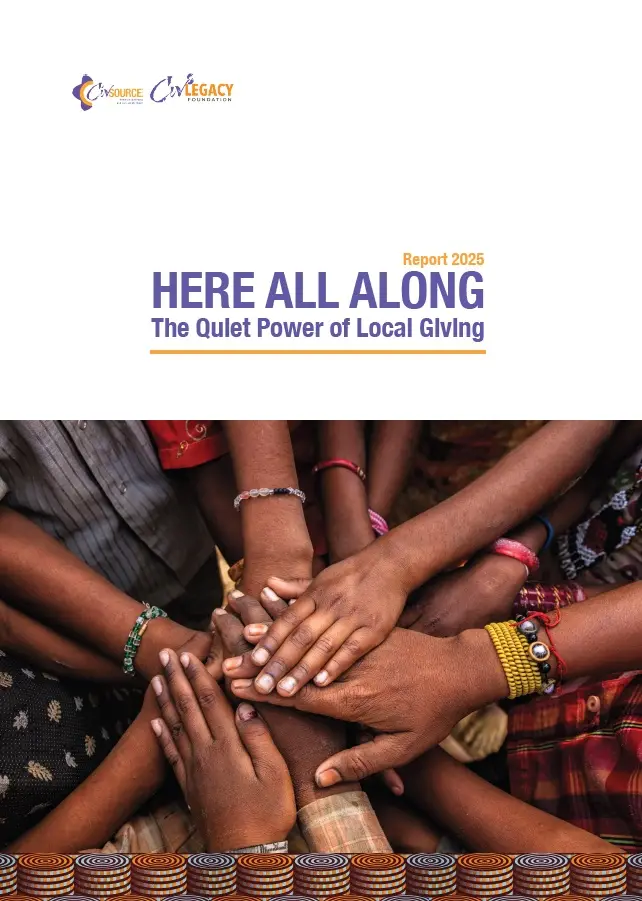
This report presents findings of a study that was commissioned in 2025 by CivSource Africa in collaboration with the CivLegacy Foundation, and which aimed to spotlight the contribution of local philanthropy in Uganda’s social justice ecosystem. Uganda’s social justice work is often portrayed as being dependent on foreign aid, yet the research reveals that everyday, ordinary Ugandans are actively financing and sustaining justice efforts across the country. The study, based on interviews, case studies and media analysis shows that Ugandans provide money, labour, food, transport, skills and social support that rarely appear in formal philanthropy records. These contributions, though often invisible, are driving meaningful change. In particular, the key finding shows that,...
This paper reflects on the changing landscape of development, shaped by contemporary politics, aid regimes and policy shifts in India. Drawing on examples from the author’s NGO practice, it examines the dilemmas faced by civil society organizations amid shrinking civic space. The paper argues for community philanthropy, the value of local knowledge and people’s mobilization as powerful, values-driven alternatives to dominant aid and charity-led development models. The report summarizes the author’s conclusions about what works in community philanthropy – and how community-led development can be supported – based on the experience of the Keystone Foundation supporting and engaging communities. Author: Snehlata Nath, Keystone Foundation and 2024 / 2025 #ShiftThePower Fellow Published by: GFCF Published:...
This paper explores community philanthropy, a practice rooted in locally-owned and controlled resources. It is increasingly recognized for its potential to drive transformative change and shift power dynamics. Unlike traditional top-down development aid, it mobilizes local assets, capacities and knowledge to build trust and collective action. The objective of this research was to analyze the relationship between community philanthropy and social justice movement building, specifically, to: Determine how community philanthropy strengthens or builds "bonding" and "bridging" social capital within social justice movements. Examine how community philanthropy fosters collaboration and solidarity among various social justice causes, such as economic justice initiatives. Investigate how community-based funding and resource mobilization strategies enable grassroots...
This research project began at the end of 2024, at the cusp of a new era of unprecedented cuts to foreign aid, or Official Development Assistance (ODA). The swift and severe nature of the cuts, from the United States, the United Kingdom and many more Global North bilateral donors, reaffirmed that unilateral, top-down funding sources cannot serve the cause of decolonizing international cooperation, or of building a new, equitable system. This research on flexible funding models does not start from a "neutral" standpoint. The authors believe that flexible funding is both vital and preferable to existing mainstream, rigid forms of funding. And it is a crucial part of shifting both power...
This report is based on a virtual session held on 30 October 2025 — a year that laid bare the fragility of the global funding ecosystem as we have known it. Yet this moment is not entirely new. For years, traditional funding models and NGO structures have proven inadequate, extractive and disconnected from grassroots realities. In response, organizations and movements across the world working in pursuit of more just, equitable and peaceful societies have been reimagining how social change is resourced — shifting the focus from money alone to questions of power, voice and agency. Many of us are looking within communities, drawing on creativity and long-held traditions of solidarity...
In this paper, Karolina Soliar reflects on her experience of advocating for Ukrainian local organizations during her time with the National Network of Local Philanthropy Development. The paper aims to join the dots between the concept of claiming the narrative, the role of story-telling and the need to re-shape the humanitarian system. In humanitarian work, a story is often viewed as something soft – a case study, a testimony, a success vignette. In practice, a story could be a narrative unit that will push in one direction or another. And like any unit, it can be assembled, directed, scaled and weaponized. It has mass, momentum and political consequence – depending on...
Languages available: English Українська
Despite growing demands and growing awareness about the importance of shifting power, progress has been slow, particularly among international organizations such as foundations, bilateral agencies and international non-governmental organizations (INGOs). These institutions continue to control the majority of capital - determining where resources flow, under what conditions, and through which systems and processes. This raises critical questions: In light of growing demands to shift power, why has change among funders been so limited? What can be done to help funders meaningfully shift power? This research study contributes to answering these questions by exploring: why and how funders begin to shift power, the barriers and enablers that shape their journeys, and strategies...