Introducing the Possible Now Stitching Fellows
27 Jul 2026

As we further develop Possible Now, particularly on the road to the 2026 Summit in Kathmandu, we are delighted to announce the new Possible Now Stitching Fellowships. These are resourced fellowships for bridge-builders who are seeking to explore big questions from the perspective of emerging practice, to dissolve the boundaries of categories and siloes – which have too often artificially divided us – with a view to building “a bigger us.” Work undertaken as part of the Stitching Fellowships will aim to knit across divides and to foster systems and political consciousness within civil society and people-led action more broadly. The mandate of the Fellows is to listen, reflect, convene, translate, create and align.
Read more below to meet the Fellows, and to learn about some of the work they will be busy with in the coming months! More Fellows will be announced in the weeks to come, so keep checking back here.
Ricardo Arévalo, Monteverde Community Fund (Costa Rica)
 Through my Possible Now Stitching Fellowship, I will research the cultivation of the commons — specifically, how organizations can generate agency, reach and sustainability by building social capital and providing services that are coherent and relevant to communities. This involves generating both social and financial returns by achieving their objectives, specially in areas where governments and / or markets fail to fulfil. The goal is to explore hybrid scenarios where non-extractive economic practices and community philanthropy mutually reinforce one another, while also identifying potential challenges and tensions. With this work, I aim to contribute to envisioning new scenarios aligned with the philosophy of Possible Now.
Olga Bentz
I am the author of Beyond Survival: Regenerative Organizational Development Support in Wartime Ukraine and founder of ODeSA – Organizational Development Support Agency.
My Possible Now Stitching Fellowship will explore how we can engage with futures from within wartime and other difficult realities in ways that cultivate agency and hope rather than overwhelm. I will ask whether thinking about futures is worth investing scarce time and resources in when the present is so demanding; how we can engage with futures when the future itself may feel frightening; and how such practices might move beyond individual organizations and small groups to connect more diverse people and perspectives.
Through research, learning and conversations across regenerative organizational development, futures thinking, philanthropy and peace-building, I hope to explore what these fields might learn from one another. There is something deeply paradoxical about asking people living through war to look towards uncertain futures: we are already living inside a reality that, seen from the past, would have seemed both frightening and almost unimaginable. And yet, within this reality, people continue to create, connect and make choices about what comes next. Perhaps this is precisely where the work of imagining futures needs to begin.
Lena Bheeroo (UK)
 My Possible Now Stitching Fellowship will look at movements that have historically had to ask power for the resources and recognition they need, racial justice, LGBTQIA+, disability justice and climate movements among them. I want to explore what it looks like for these movements to build power from within. I believe some of the strongest energy for this already exists, but is just not yet joined up. Community philanthropy, community organising, mutual aid and the wider funding space have too often been treated as separate, when the diagonal relationships between them may be exactly where new capacity could come from. Movements have often lived in the urgent minute, taking money to grow faster and sometimes losing values along the way, burning out in the process.
I want to explore what it would take to build connections between movements that truly outlive a funding cycle, using social capital as the messenger that gives communities room to imagine the world they actually want. This exploration will feed into the Possible Now Summit in Kathmandu in December.
Daniela Cevallos, Fundación Ñeque (Ecuador)
 I am a cultural anthropologist based in Ecuador, working at Fundación Ñeque, where I accompany community-led socio-environmental initiatives across diverse territories. My work is guided by a curiosity about how people make sense of change in their own lives, organizations and communities. Over the years, I have become fascinated by the narratives that linger long after workshops end, reports are written, and projects close: the stories people share over meals, during breaks, or on the bus ride home; those quieter moments of trust, when people reflect more openly on what truly mattered to them. As part of GFCF’s Measuring What Matters community of practice, I have been exploring how we listen for those narratives, and what they might reveal about relationships, learning and collective action. Through my Possible Now Stitching Fellowship, I hope to continue following these threads alongside women leaders from across Ecuador, and to learn what their experiences can teach us about trust, community philanthropy and community-led transformation.
Gastón Chillier (Argentina)
 We are living through a moment in which democracy is eroding, authoritarian and anti-rights forces are gaining ground, and the climate crisis is accelerating. At the same time, the rapid development of artificial intelligence is opening profound questions about human agency, power and how much control we will retain over technologies whose capacities and autonomy are expanding faster than our ability to understand their consequences. All of this is happening while our capacity to imagine convincing political alternatives seems increasingly constrained.
Human rights and social justice movements have built a powerful repertoire over the past decades: legal strategies, advocacy, research, documentation, and increasingly professionalized organizations and networks. But having spent more than thirty years working within this field, I have also become increasingly aware of its limits. The question for me is not simply how to improve or add to this repertoire, but what might happen if it ceased to occupy the centre: if it entered into a more open and less hierarchical relationship with other ways of knowing, imagining and acting, allowing itself to be challenged and transformed in the process.
A question has increasingly come to organize my work: how can we recognize practices, relationships and forms of knowledge that are already opening different possibilities in the present, and use them to imagine and build more desirable futures that do not yet exist? This is what I will be exploring with my Possible Now Stitching Fellowship, particularly considering what becomes possible when worlds that are often kept separate enter into sustained conversation. I hope to cross some of the binaries that continue to organize our fields: local / global, expert / community, donor / grantee, modern / ancestral, activism / art, present / future.
New! Stefan Cibian (Romania)
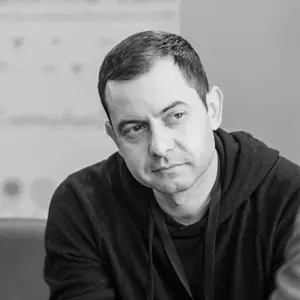 The current multilateral, rules-based order is under strong attack. Technology fundamentally transforms social relations while also generating virtual spaces that are increasingly controlled and weaponized. The extreme right, exposing illiberal tendencies, is slowly rising to power in several countries around the world. These forces are aligning with authoritarian regimes globally, while slowly dismantling democratic systems at home. Citizens vote for extreme-right or sovereignist political forces that feed on their fury and disillusionment, and which are struggling to capture state power without clearly exposing their motivations. While the post-World War II world order has not been ideal for all people everywhere, it generated and consolidated, in democratic countries, a certain balance of power between state power and the citizenry through the institutionalization of human rights and democratic institutions. Moreover, a global human rights regime emerged based on multiple international agreements and conventions. As this global order erodes, we can expect human rights and the balance of power between the state and the citizen to change as well. My Possible Now Stitching Fellowship will explore conversations and scenarios related to the transformation of the rules-based world order and its impact on human rights, civil society and local communities’ capacity to shape the futures they hope for.
Nina Fitzsimons (Australia)
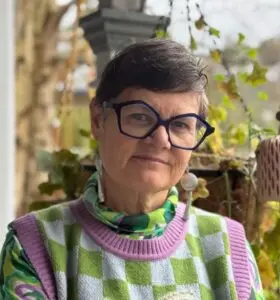
My Possible Now Stitching Fellowship will explore how different ways of understanding and measuring change can emerge and survive within systems that continue to prioritise conventional approaches to monitoring, evaluation and learning.
The inquiry will start with my own experience. After more than 20 years working in international development, I moved into community philanthropy and found myself questioning many of the assumptions about measurement that had shaped my practice. In trying to develop a social impact approach for a small community foundation in Australia, I experimented with bringing community voice, local data, stories and organizational learning together to better understand what mattered to the community and what change looked like. But I also experienced how difficult it can be to work differently when established systems keep pulling us back towards familiar ways of demonstrating impact.
My work will follow the places where alternative practices are already emerging. Ultimately, I want to understand how we might become more deliberate about finding, connecting and strengthening these emerging practices, and what that might offer the wider Measuring What Matters and #ShiftThePower movements.
Matt Haikin (UK)
 AI is transforming almost every aspect of society, and faster than any previous wave of technology.
There are enormous potential benefits to responsible and careful use of AI tools, though the technology also comes with significant risks and harms. These include social / ethical harms (e.g. energy and water use and the accompanying environmental impacts of hyperscale datacentres, hollowing out of jobs, increased concentration of power in the hands of a very small number of private US and Chinese companies) as well as more practical risks of harm (e.g. biased training data and hallucinations leading to inaccurate results and the changing of what counts as “truth”, potential cognitive offloading impacts on learning, deepfakes, the homogenization of writing).
There is a wealth of material in the public domain offering advice on how to use AI tools more effectively, and almost as much warning against AI’s potentially devastating impacts on society, but there is comparatively little that is nuanced harnessing AI for good while minimizing or mitigating (though rarely removing entirely) its negative impacts. Include an explicit lens of power dynamics, however, and the available material dwindles to next to nothing.
I plan to explore exactly this space – the overlap of the opportunities and harms of AI with a power dynamics lens and, more specifically, a focus on how AI supports or conflicts with #ShiftThePower or locally-led development agendas. Specifically, I will be asking:
- How can the #ShiftThePower community take advantage of the opportunities of AI to further its goals, while minimizing harms and without exacerbating the power inequalities inherent in the AI sector.
- Is there a #ShiftThePower role that targets these specific AI power inequalities directly – for example, does supporting the development and usage of “local” AI models fundamentally change these inequitable power dynamics (or at least soften them) or simply displace them to other actors.
Severus Hama-Owamparo, Taala Foundation (Uganda)
 Audacity brought us here. But audacity does not erase memory. Through my work at Taala Foundation, I have seen how trust can bridge enormous gaps in mental health care. I have also learned that care never begins on untouched ground. As Taala’s community-led Mental Health Response Network has grown across borders, I have watched it meet wounds left by systems that gathered people’s data, stories and pain without returning meaningful change. Across the Network, a recurring concern can be paraphrased as: Why should I share my data and experiences if an organization uses them to attract funding, but nothing in my life changes? That question stays with me: what do we owe someone who has trusted us enough to share what they have lived through?
Graciela Hopstein (Brazil)
 The Possible Now Stitching Fellowship aims to continue the process of reflection initiated during my #ShiftThePower Fellowship. In fact, this new Fellowship offers an opportunity to follow-up on some of the ideas proposed in my paper The Crisis of Democracy and Civil Society: Challenges and Perspectives for the #ShiftThePower Movement (also available in Portuguese and Spanish). In this next phase, I will map and analyse strategic civil society players and dynamics in Brazil, taking into account the current political context marked by the presence of far-right dynamics and actors, a democratic crisis, shrinking civic spaces and politically-driven funding shifts. This initiative will combine the development of research involving the mapping of players and networks, the creation and promotion of permanent and open spaces linked to Possible Now, agenda building (around priority themes, concerns and debates) and the development of joint actions.
Facundo Ibarlucía, Red Comunidades Rurales (Argentina)
 In the face of rapid technological shifts, what is possible now to build directly from civil society and through genuine community participation to protect our ecosystems and empower our trust-based civic infrastructure? This is the question I will be exploring with my Possible Now Stitching Fellowship, specifically looking at:
- Accessible tech and AI literacy: Providing a clear, plain-language baseline on what these emerging technologies actually are and how they work. Demystifying it is essential so community leaders feel empowered rather than intimidated.
- The socio-environmental impact: Understanding how technological innovations are transforming individuals, communities, ecosystems and international relationships. What are our organizations going through?
- Community appropriation and innovation: Mapping existing local practices, digital rights and genuine tech sovereignty already taking place on the ground. What is possible now?
- Reframing grantmaking: Addressing the “AI arms race” (AI writing proposals vs. AI scoring them) to push the philanthropic sector back toward trust, relationships and human connections. This is also linked with what important decisions we are delegating and why.
Nishchhal Kharal, Freedom Studio (Nepal)
 With my Possible Now Stitching Fellowship, I am exploring “artivism”, specifically how art and creative practice shape narrative, and how the civil society sector can use creative approaches to tell stories that bring people together. I will be looking at how extremist and algorithm-driven narratives spread, and how creative story-telling can instead build social cohesion and trust. Working with artists and communities across my networks, I will be experimenting with community-led ways of telling stories that resist extractive, feed-driven models. Much of this will come together at the Possible Now Summit in Kathmandu this December, where I – along with Freedom Studio – will bring a creative community-building experience, using art and exploring narrative alternatives together.
Marina Kobzeva (UK)
 I have spent around twenty years in humanitarian work, at every rung of it: on the receiving end of aid, then as national staff, a “field” worker and eventually an INGO Director. All of this taught me how much local crisis response competence is overlooked, because our optics are not calibrated to see it.
My Possible Now Stitching Fellowship supports the “Already There” research initiative, a growing public record of local crisis responses, told by the people who do it. This began with four years of asking communities in fifteen countries one question: “What does help that really helps look like?” We heard back, without exception: “Look at what we are already doing, and help us do more of it.”
Now I am having conversations with local responders across more than twenty contexts, in their own languages and on their own terms, alongside creating a living map of who is already there when a disaster strikes. People nominate themselves or each other, and legitimacy extends horizontally. Surfacing this work is the main purpose of my Stitching Fellowship, because recognition is upstream of resourcing, and what is kept invisible stays dismissible. Above all, I want to help make responders visible to each other so that people facing similar crises can find and support one another directly. Much of this feeds into the Possible Now Summit in Kathmandu in December, though the longer aim is to contribute to shifting who gets seen as legitimate, competent, fundable and central to any crisis response.
New! Mara Livermore (UK)
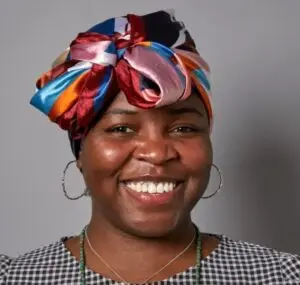 I am a cultural strategist, civic practitioner, ancestral devotee, researcher and law student, curious about how power moves over time. My Possible Now Stitching Fellowship asks how England’s legal system, and its global reach, structures our relationship to resource — nature, capital, cash and each other. Humanity is consuming resources 73% faster than Mother Earth can regenerate them. In 2026, society had used up a year’s resources by July 30th. This isn’t equitably distributed: the UK’s overshoot date is May 22nd; Ecuador’s is November 12th; Nigeria doesn’t make the calendar at all. Shifting behaviour isn’t enough. My practice explores fundamentally different paradigms for human existence in high GDP nations and this Fellowship allows me to ask how praxis from innovation, creativity, civic engagement, nature and the ancestors are helped or hindered, by the law.
Michael Vincent Mercado, Center for Disaster Preparedness (Philippines)
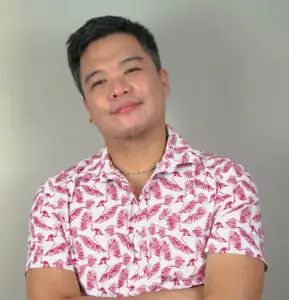 Most of my working life has been spent making documentaries about communities in the Philippines, which means I have also spent it deciding what becomes visible and what remains outside the frame. Again and again, our “proposals” and impact videos begin with what a community lacks. By the time money enters the story, external support has already been cast as the protagonist, while everything the community has built, including its relationships, knowledge, labour, systems of care and ways of organizing, has disappeared from view.
When communities can tell a different story about what they already carry, what gets counted changes. And when what gets counted changes, what gets resourced can follow. Both the narrative and the resources must be in service of the community: its priorities, its decisions and its sovereignty. Otherwise, the grant appears to be the whole budget, while everything the community contributes is valued at zero. This settles whose project it is before anyone has discussed it. Sovereignty is difficult to claim over resources whose existence no one acknowledges.
My Possible Now Stitching Fellowship is an experiment in bringing narrative, recognition and resourcing back into the same ecosystem. I want to explore whether making visible what communities already hold can help unlock resources that they themselves control. I also want to understand what those of us outside the community must do differently for that control to endure. The test is not whether we can tell a more compelling story, but whether that story strengthens community agency and changes where resources flow.
New! Rituu B Nanda (India)
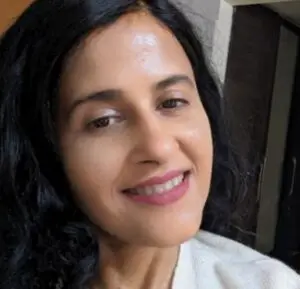 Through my Possible Now Stitching Fellowship, I hope to deepen my understanding of the factors that enable or constrain community ownership and action. My research question was co-created through conversations with a group of people. Here, “communities” refers to people with lived experience, local neighbourhoods, and geographical communities, recognizing fully that communities are not homogeneous.
Chris Nkwatsibwe (Uganda)
 What if the future of civil society depends not only on where it finds resources, but on how it relates to the creation, ownership and stewardship of economic value? This question sits at the heart of my Possible Now Stitching Fellowship. I am exploring whether — and under what conditions — civil society might build or participate in ethical forms of value creation while preserving its civic purpose, democratic legitimacy and public trust.
The fellowship emerges from a growing recognition that shrinking aid, changing philanthropy and evolving political realities are exposing the limits of conventional conversations about financial sustainability. Rather than asking only how civil society can mobilize more resources, it asks whether a different set of questions is now needed — questions about ownership, institutions, the governance of economic value and the material conditions that enable civic life to flourish. Rather than searching for ready-made models, the fellowship will map an emerging landscape of ideas and practice, from community philanthropy and democratic ownership to cooperative enterprise and new institutional forms, to understand what they might teach us about the future of civil society. Ultimately, it is an exploration of how civil society might remain an independent and transformative force while helping shape economies that are more democratic, regenerative and rooted in community.
New! Barbara Nöst (Zambia)
 Having been in the formal civil society sector for a long time, I have become increasingly interested in alternative ways of organizing to bring about the change we want to see. This interest led me to organizations experimenting with different dimensions of organizing, including internal organizational structure, governance and decision-making, ownership, influencing strategy and underlying economic paradigm. Some are driven by the idea that flatter organizational structures can lead to better outcomes, while others have experimented with steward-owned enterprises and holacracy. Some focus on bringing about change from within existing systems. Others argue that new forms of organizing and collective action need to be situated within broader concepts such as degrowth, post-growth or the economy for the common good. Despite their differences, those who promote these new approaches question conventional ways of organizing and share the conviction that organizing differently and building organizations differently may create different possibilities for change. With my Possible Now Stitching Fellowship, I will explore what happens when organizing happens differently, and whether changing how people organize, structure their collaboration, relate to one another, and mobilize their assets creates different conditions for bottom-up change.
Elizaphan Ogechi, Nguzo Africa Community Foundation (Kenya)
 The world is becoming more unpredictable. Trust in institutions is reducing, inequality is hardening and systems that were meant to hold communities together are fragmenting due to competition for scarce resources. This is happening while the world is in a poly-crisis where economic, geopolitical, environmental and social problems are occurring concurrently, are interconnected and unfolding at bigger scale. Clearly, no single organization has the capacity to respond and solve any of these challenge alone.
For decades, community foundations have been built around common practices: grantmaking, convenings, appreciating local knowledge, measuring what matters, building institutional legitimacy and mobilizing community assets. But having spent 21 years working in community organizations in Kenya, I have also become increasingly aware of their limits. The question for me is not simply how foundations can do more of what they already do, but what might happen if the organization itself stopped being the unit from which we measure success. What if, instead, relationships, connections and the health of the wider web of actors became the organizing pillars for success?
One question in particular has been on my mind: how can community foundations use the Doughnut Economics framework and a relational infrastructure approach to revive citizen action, build collective visions, strengthen the connections between actors, and drive change that no single organization could achieve alone? This is what I will be exploring with my Possible Now Stitching Fellowship, particularly by mapping the patterns, partnerships and relationships that already exist in a community (in this case, across Narok and the Lake Basin counties of Kenya). This will take shape as a Community Power Map: zoomed out, it will show the relationships, priority issues and actors already at work; zoomed in, it will show the specific connections making things happen.
Pepe Onziema (Uganda)
 My Possible Now Stitching Fellowship will investigate how marginalized communities create and sustain collective power beyond formal organizations and international donor support. Focusing on Uganda’s LGBTQ+ movement and the emergence of QuchuCoin, I will explore community philanthropy, mutual aid and the networks of trust that enable movements to endure. I will also examine the often unrecognized people and places that make organizing possible, from small businesses and artisans to cafés and other everyday spaces where community and solidarity quietly take root. Ultimately, I hope to contribute fresh thinking on how African social movements can sustain resilience, belonging and long-term viability from within.
Otros Futuros: Gabriela Franco Prieto (Colombia) and Guillermo Schoning García (Mexico)
 Like most of our own territories, we understand the future to be another occupied territory and a sacrifice zone. Pervasive narratives of collapse and apocalypse dispossess us of our world-making agency and pave over any other ways of relating to and understanding the future. The alternatives are already here, some have resisted for decades. If other futures already exist where are they? How can we learn from them? And how can we articulate the communities that are already exercising them in the present? otros_futuros is a Latin American climate and community imagination laboratory focused on refusing apocalypse, creating contagious futures and propagating community world-making methodologies, based on the seeds of alternatives that already exist. We use biomimicry, third world speculative science fiction, and pedagogy of the oppressed to create replicable methodologies for radical community imagination, that can sow crises with possibility and refuse apocalyptic narratives through practical, existing paths. We have tried and tested our methodologies through games and community convenings in Colombia and Mexico, mainly focusing on grassroots movements from ecofeminism and anti-extractivist movements to waste workers.
With our Possible Now Stitching Fellowship we are expanding beyond Latin America, and piloting a methodology with Mawjud for Global South practitioners to jointly imagine what making global policy can look like in a radically different, alternative, desirable future. Inspired by the Zellij mosaic art from North Africa and guided by a “Maalem” committee of decolonial experts across disciplines, we are assembling a mosaic of concepts, practices and philosophies that can be contagious across the Global South for lateral universalism. Our hope is that piloting a replicable methodology that can guide Global South practitioners and communities in cultivating radical imagination can enable other possibilities in policy making and open up pathways for practical, plural, liberatory architectures.
Florencia Roitstein (Argentina)
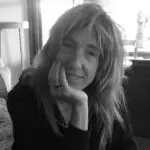 My Possible Now Stitching Fellowship will explore a question that may sound simple until you try to answer it: What if the future of the natural commons — and water in particular — is fundamentally a question of power? Who decides who gets water? Who controls it? Who profits from it? And who is left thirsty?
Water is life. Yet we have increasingly treated it as a commodity — something to be extracted, traded, controlled and accumulated. I want to bring water to the centre of conversations about some of the contradictions we keep pretending are separate: inequality, privatization, extractivism, democracy and territorial rights. Because when water is privatized, communities lose more than access to a resource — they lose part of their capacity to shape the conditions of life itself.
But this is not a conversation about crisis and catastrophe. It is an invitation to pay attention to what is being created: the knowledge, practices, solidarities and forms of resistance emerging in the cracks of the dominant system. Across the Global South, communities and movements are defending water as a common and experimenting with forms of collective governance rooted in care, reciprocity, territory and the rights of nature. Their struggles remind us that another relationship with water — and with one another — is not only possible but already being practiced.
Alda Salomão, Fundo Tindzila (Mozambique)
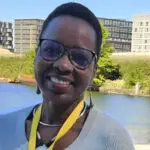 The question I intend to explore through my Stitching Fellowship is this: How, in practice, can local actors use the powers and resources they have to shape community-based and community-led development in ways that recognize the existence, role, and agency of all stakeholders and their respective assets, and that promote a better balance between internal and external interventions? I am particularly interested in locating this work in the political economy of natural resource management (including decision-making powers over and the economic value of land and natural resources) and to explore how both the recognition of natural resources and other types of community assets can strengthen communities’ power to leverage external funding more equitably.
As well as looking outwards and connecting with others who are exploring similar kinds of questions, I will be basing my fellowship in the lived experience of two communities in southern Mozambique.
Yousra Semmache, Mawjud (Algeria)
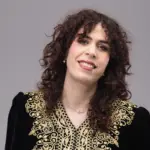 With my Possible Now Stitching Fellowship, I am piloting Zellij x Otros Futuros, a methodology for practitioners to jointly imagine what making global policy can look like in the future. Inspired by the Zellij mosaic art from North Africa, and working alongside grassroots movements from the Global South and beyond, we are assembling a “mosaic of discourse” made of concepts, practices, and philosophies from across the world. Zellij is a cornerstone of Mawjud, a movement I recently started to build a new, liberatory architecture for global power. By joining forces with the Latin American imagination collective otros_futuros and a “Maalem” committee of decolonial experts across disciplines, Zellij x Otros Futuros aims to assemble a lateral universalism from plural traditions and emerging practices.
My fellowship will therefore attempt to build early evidence for this new universalism – the discursive foundations of a world where we can exist. Together with otros_futuros and the Guinean philosopher Alioune Bah, I will present the Zellij x Otros Futuros imagination practice at the Possible Now Summit in Kathmandu, Nepal this December. Ultimately, I hope that imagining collectively what discourse will support a new architecture of policymaking will help grassroots movements embody a future where we lead it.
New! Era Shrestha and Amina Singh (Nepal)
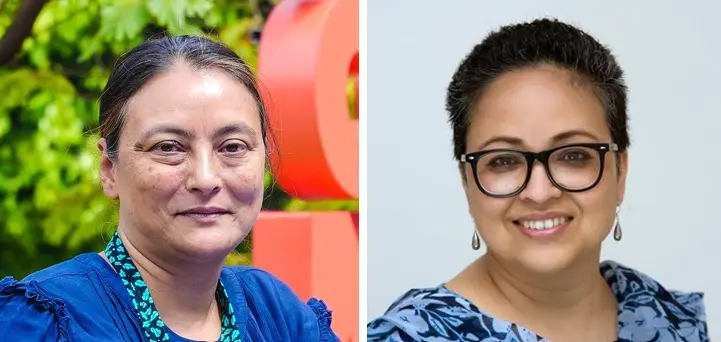 The discourse on localization and shifting the power has challenged the dominant model of development by asking who defines development priorities, controls resources and makes decisions to influence change in communities. Yet, evidence and practice indicate that the transfer of resources and responsibilities to local organizations in the Global South does not necessarily transform power relations. Local organizations may continue to operate primarily as implementing units while community organizations emulate the modern professionalized managerial mode of organizing, prioritizing managerial efficiency over accountability and rootedness within their constituencies.
Through our research, we argue that if shifting the power is to represent a genuinely different development paradigm, it requires reimagining a different institutional practice of development. Hence, the research is guided by the question: for power to be genuinely shifted to the communities, what should be the role and function of locally-rooted institutions? The research to be carried out with our Possible Now Stitching Fellowship will explore how community-embedded organizations may move beyond managerialist modes of organizing and develop alternative institutional forms and practices grounded in local histories, knowledges, assets, aspirations and ways of organizing. We hold the assumption that there are existing alternative community practices in Nepal based on indigenous forms of organizing that may offer useful perspectives and insights. Ultimately, we hope to develop an understanding of how locally-rooted institutions can hold and exercise greater decision-making authority on behalf of their constituencies, enabling communities to exercise collective agency and shape their own futures.
Gugo Siqueira, Rede Comuá (Brazil)
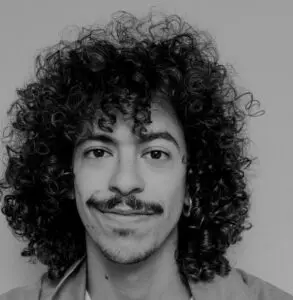 At a moment when tradition is treated as a conservative monopoly, “Proud to be a CROWD” is a Possible Now Stitching Fellowship exploring the possibilities of collective resourcing, imagination and resistance through the traditional festivals in Brazil. My goal is to understand how these festivals challenge static definitions of tradition to reclaim rights and expand the possibilities of democratic participation. Observing the movement of a CROWD, a common aesthetic across these festivities, some key questions emerge:
- How does this shared experience transform fear, chaos and impossibility into political and cultural vitality?
- How do traditional festivals establish alternative and ancestral economies of abundance, dynamic resource-sharing, and mutual care in direct contrast to scarcity?
- What is the role of tradition in building spiral, multi-temporal spaces where past, present and future intersect?
This research builds upon ongoing experiments by Rede Comuá around narrative work and new convening formats through the creation of a participatory festival on philanthropy and democracy. Using traditional festivals as a narrative thread, we are exploring ways to expand the framing of community philanthropy and ground public debate in concrete cultural practices where participation, public rituals of fundraising and asking, as well as mutual care, are lived daily experiences. Rethinking tradition and its relationship with time and language is fundamental to our efforts.
New! Matt Tutt (Spain)
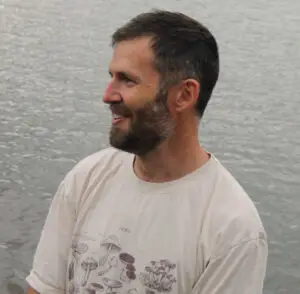 There’s been a significant increase in the negativity shown by people towards AI and BigTech in recent years. There are some very well established, funded and organized response movements that seek to attract and mobilize people around taking action, but much of these movements seem to be focused on approaching the topic from a reformist angle; that the tech isn’t inherently bad, that it just needs to be tweaked, modified or controlled in some way.
The aim of my Possible Now Stitching Fellowship is to research and document the response to AI and BigTech, to try and trace the underlying funding behind some of the larger movements, and to make connections within the Effective Altruism space. I want to understand, in fighting back against BigTech and AI, whether the majority of these movements are in fact guilty of perpetuating what these tech companies have historically been doing, particularly to people based in the Global South. Are there genuine ways in which we can look to stop the rise of BigTech and AI collectively, to protect and benefit our societies and local communities, or in doing so are we just shifting the problem further down the path for future generations to have to tackle?
And to what extent do these problems tend to attract privileged people with a tech background, and thus marginalize those voices who might have the most impactful and meaningful advice to share; those who may be existing in current liberation movements within the Global South but aren’t invited to have a say? How can we bridge the response to BigTech and AI movements to those liberation movements so that we can be confident that we aren’t seeking to apply some kind of technological fix whilst operating within a silo.
Kedolwa Waziri, Trans and Queer Fund (Kenya)
 My Possible Now Stitching Fellowship will explore space not just as a place where community organizing happens, but also space itself as an active and alive organizer in our movement work. Over the past couple of months, I have looked at the value of physical space for movements, and found that space is not only a resource, but also a relational infrastructure that shapes the political, emotional, ecological, spiritual and metaphysical conditions under which collectives flourish. For movements, organizing without a dedicated space means constantly negotiating uncertainty, adding to the instabilities that are present in movement work. With public spaces shrinking and policing expanding around the world, the absence of permanence, belonging and rootedness is an emerging disruptor of our collective imagination.
Ultimately, I will explore space as a site of relationship, challenging dominant capitalist notions of ownership. When space becomes our co-organizer, where we belong to the space and the space belongs to us, we are invited to a responsibility of mutual care and protection, and the freedom to imagine beyond limited space is made possible. I hope that this exploration can allow us to see the kind of relationships our spaces invite us into and what kinds of people those relationships allow us to become through practices of world-building and collective sense-making towards alternative futures.
Dina Zayed (Egypt / UK)
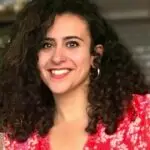 My Stitching Fellowship will help me lead an action-learning and facilitated series of convening conversations that bring together two issues often studied and engaged with apart: the global retreat of democracy and an accelerating climate crisis. More countries are transitioning to autocracy than to democracy, and the number of democratic countries has fallen to its lowest point in decades. With just 7.2% of the world’s population living somewhere where civic space is rated open or even narrowed, conditions for civil society organizing are becoming more difficult virtually everywhere. This research and convening series on the road to the Possible Now Summit in Kathmandu is exploring how we can build adaptive civic infrastructure under, through, and despite greater restrictions.
As a Fellow, I am working on tracing emerging practices and visions that captures what community-led democratic innovation for climate resilience already looks like, especially in the most unlikely of places. The fellowship makes the case that working on climate change without engaging with a shifting civic order means not fully understanding the realities vulnerable and frontline communities navigate to organize, adapt, and hold power accountable. A networked and decentred project, I am interested in learning how we are operating to meet a shifting political moment, and what these tactics tell us about the alternative shapes in which expressions of civic agency are made.